



Before federal regulations stepped in, securing a loan was a financial minefield. Banks could hide predatory terms behind pages of dense legal jargon, leaving borrowers with unexpected fees and sky-high interest rates.
Understanding your rights under the Truth Lending framework is your best defense against modern deceptive lending practices. By forcing financial institutions to lay their cards on the table, this protective legislation turns complex borrowing into a transparent transaction.
Key Insights / Quick Summary
For those seeking a rapid breakdown of their consumer protections, this summary covers the essential elements of how the Truth Lending guidelines secure your financial health.
| Protection Feature | What It Protects | Real-World Impact |
|---|---|---|
| Standardized APR | Mortgage, auto, and personal loans | Forces banks to disclose the true cost of borrowing, including hidden fees. |
| Right of Rescission | Home equity loans and refinances | Provides a 3-day cooling-off window to cancel the loan without penalty. |
| Advertising Transparency | All consumer credit advertisements | Prevents bait-and-switch marketing by requiring full disclosure of trigger terms. |
| Fair Credit Billing | Credit card transactions and open-end lines | Caps unauthorized charge liabilities at $50 and mandates billing dispute processes. |
What is the Truth Lending Act (TILA)?
The Truth in Lending Act (TILA), enacted in 1968 as part of the Consumer Credit Protection Act, revolutionized how banks interact with individual consumers.
Implemented by the Federal Reserve under Regulation Z, this federal law does not regulate how much interest banks can charge. Instead, it ensures you can make apples-to-apples comparisons between competing financial institutions.
Prior to these standardized Truth Lending rules, lenders used a bewildering array of formats to present interest rates. This confusion made it nearly impossible for everyday borrowers to recognize predatory loan products.
Today, the Consumer Financial Protection Bureau (CFPB) oversees these requirements. To explore the legal codification of these consumer safeguards, you can reference the official CFPB Regulation Z guidelines directly.
The “Federal Box” Disclosures
At the heart of every credit agreement is a visual disclosure block colloquially known as the “Federal Box.” Lenders are legally required to display this standardized segment before you sign any paperwork.
This clean, visually scannable block highlights four crucial pillars of information:
- The Annual Percentage Rate (APR)
- The total finance charge of the loan
- The amount financed by the borrower
- The total of all payments over the life of the loan
By standardizing this layout, Truth Lending regulations ensure that no bank can bury critical loan costs in microscopic print at the bottom of a contract.
APR vs. Nominal Interest Rate
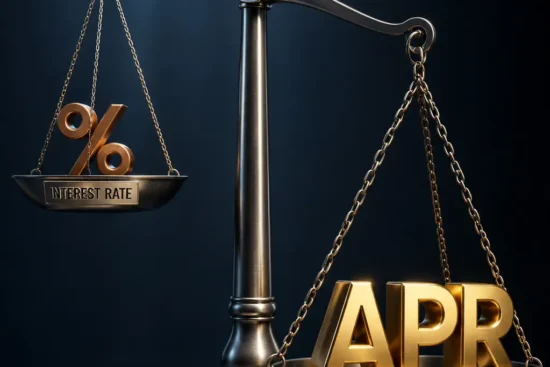
One of the most powerful shields provided by the Truth Lending Act is the mandatory disclosure of the Annual Percentage Rate (APR). Many consumers mistakenly assume that the nominal interest rate is the total cost of their loan.
The nominal interest rate represents only the basic cost to borrow the principal balance. It completely ignores the auxiliary fees that banks use to pad their profits.
Conversely, the APR reflects the total annual cost of credit, compounding the nominal interest rate along with lender fees, broker costs, and origination charges.
We can express the mathematical difference between a basic loan cost and the APR using the following calculation:
Let the principal loan amount be P, the total interest paid over the term be I, and the upfront financing fees be F. The total borrowing cost C is defined as:
C = I + F
When calculating the real APR over a specific number of days d, the formula becomes:
APR = (C / (P * d)) * 365 * 100
Without standard Truth Lending calculations, a bank could offer a seemingly low interest rate of 5% while charging thousands in hidden closing fees, masking the true APR of 7.5%.
The Power of the Right of Rescission
Perhaps the most potent defense mechanism embedded within the Truth Lending laws is the right of rescission. This rule provides a vital buffer zone for homeowners who may have rushed into a risky financial agreement.
Under these guidelines, if you secure a loan using your primary residence as collateral—such as a home equity line of credit (HELOC) or a refinance—you have a legal right to cancel the contract.
This cooling-off period lasts exactly three business days, starting from the moment you sign the contract, receive your Truth Lending disclosure statement, or receive your notice of right to cancel (whichever occurs last).
Lenders cannot distribute funds or perform services during this window. If you choose to rescind, the bank is legally required to return all fees and cancel any property liens within 20 calendar days.
To see how regulatory bodies audit these protections, you can read the FDIC Truth in Lending Act portal, which outlines strict enforcement measures for non-compliant banks.
How TILA Protects Your Credit Cards
While many associate Truth Lending guidelines with mortgages and auto loans, the legislation also heavily regulates open-end credit lines, including your credit cards.
If your credit card is lost or stolen, your maximum liability for unauthorized charges is strictly capped at $50. If you report the loss before any unauthorized transactions occur, your liability is zero.
Additionally, amendments to the act established structured timelines for billing disputes. Banks must acknowledge your written dispute within 30 days and resolve it within two complete billing cycles.
During this investigation period, the bank cannot take collection actions on the disputed amount or report you as delinquent to credit bureaus.
When Does the Truth Lending Act Apply?
It is vital to understand that Truth Lending protection does not cover every single financial transaction in the economy. The law is strictly calibrated to protect personal consumers rather than businesses.
                  ┌───────────────────────────────┐
                  │ Does TILA Apply to Your Loan? │
                  └───────────────┬───────────────┘
                                  │
                  Is the loan for consumer purposes?
                 (Vacation, home, personal use, etc.)
                                  │
                     ┌────────────┴────────────┐
                     ▼ Yes                     ▼ No
             ┌───────────────┐         ┌─────────────────────────┐
             │ TILA Applies  │         │   Business / Commercial │
             │  (Protected)  │         │   Exempt (No TILA)      │
             └───────────────┘         └─────────────────────────┘
The strict Truth Lending criteria apply only when:
- The credit is offered or extended to a natural person.
- The credit is primarily for personal, family, or household purposes.
- The creditor regularly extends credit to consumers.
- The loan amount falls below the annually adjusted federal threshold (unless secured by real property).
If you are taking out a commercial loan to expand a business, buy rental real estate under an LLC, or purchase heavy machinery, you will not be protected by these specific disclosures.
TILA vs. Other Financial Protection Laws
To navigate consumer finance safely, you should understand how the Truth Lending framework interacts with other major federal protection laws.
| Federal Law | Core Focus | Primary Benefit |
|---|---|---|
| TILA (Regulation Z) | Cost disclosure & billing disputes | Mandates APR calculations and the 3-day right of rescission. |
| RESPA (Regulation X) | Real estate settlement procedures | Eliminates kickbacks and regulates escrow accounts during home purchases. |
| FCRA (Regulation V) | Credit reporting accuracy | Restricts who can access your credit file and ensures correct data reporting. |
While TILA forces the bank to be honest about the cost of your debt, RESPA ensures that third-party service providers do not inflate your closing costs with illegal kickbacks.
For further regulatory definitions, you can explore the OCC Truth in Lending database, which breaks down bank supervision guidelines.
Real Cost Case Scenario: The Car Loan Trap
To illustrate the importance of these consumer rights, let us look at a case scenario involving an auto loan.
Imagine you visit a dealership where a salesperson offers you an attractive interest rate of 4.5% on a $25,000 vehicle loan over a term of 5 years (60 monthly payments).
Without transparent Truth Lending guidelines, the dealer might add a series of hidden processing fees, dealer prep charges, and mandatory gap insurance products into the loan principal.
Let us compare the true cost structure:
- Scenario A (Without Disclosures): You see only the 4.5% interest rate. You do not realize that $2,500 in hidden fees has been tacked onto your principal, raising your actual borrowed balance to $27,500.
- Scenario B (With TILA Disclosures): The dealer must explicitly present the “Federal Box” showing an APR of 7.8% rather than the nominal 4.5% interest rate, exposing the true financial burden.
By comparing the two scenarios, the Truth Lending disclosures save you from paying thousands of dollars in undisclosed finance charges over the life of the loan.
Pros and Cons of Truth Lending Protections
While TILA provides indispensable shields for average consumers, it is helpful to analyze the positive impacts alongside the functional limits of the law.
Pros
- Unmatched Cost Clarity: Standardized terminology makes it easy to compare competing bank offers quickly.
- Safety Valves: The right of rescission acts as a critical emergency exit for homeowners who feel pressured into a bad loan.
- Protection Against Theft: Strict liability limits prevent identity theft victims from facing ruinous credit card balances.
Cons
- No Rate Caps: The law does not place a limit on the maximum interest rate a bank can charge you.
- Complex Legal Scapegoats: Highly sophisticated lenders can sometimes use complex legal restructuring to bypass consumer guidelines.
- Information Overload: The volume of disclosures can occasionally overwhelm borrowers, causing them to sign documents without reading the fine print.
Common Bank Violations & Mistakes to Avoid
Even with federal oversight, financial institutions still make mistakes or push the boundaries of compliance.
Some common bank violations include:
- Understating the APR by omitting mandatory fees from the finance charge calculation.
- Failing to provide two copies of the notice of the right of rescission to every co-owner of a property.
- Puffing up loan terms in advertisements without disclosing the required “trigger terms.”
As a consumer, failing to check the primary Truth Lending disclosures before signing a contract is a massive mistake. Always review the APR first—never shop based solely on the monthly payment amount, as lenders can easily lower your monthly payment by stretching your loan term, costing you far more over time.
To ensure your local credit union or community bank is meeting federal standards, refer to the NCUA Regulation Z compliance framework to check institutional requirements.
How to Handle a Bank Violation
If you believe a financial institution has violated your consumer rights under Regulation Z, you have several direct pathways to take action.
First, document every piece of written communication, including your initial estimate sheets, final loan disclosures, and any marketing materials.
Next, submit a formal complaint directly to the lender. If they refuse to correct the error or refund overcharged fees, you can submit a consumer complaint directly through the CFPB website.
Under federal law, if a court finds that a bank willfully violated Truth Lending guidelines, you may be entitled to statutory damages, actual financial damages, and the reimbursement of your legal fees.
Frequently Asked Questions
What is the primary purpose of the Truth in Lending Act?
The primary purpose is to ensure meaningful disclosure of consumer credit terms so that borrowers can easily compare various loan products and avoid deceptive, predatory lending.
Does TILA limit how much interest a bank can charge?
No, TILA does not set maximum interest rates or caps on fees. It only mandates that all interest rates, fees, and total borrowing costs are clearly disclosed to the consumer.
What is the right of rescission under Regulation Z?
The right of rescission is a consumer protection that gives borrowers a three-day business window to cancel certain loans secured by their primary residence, such as HELOCs or refinances, with no penalty.
Is my business loan protected by the Truth in Lending Act?
No, business, commercial, and agricultural loans are exempt from TILA protections. The law is strictly designed for personal, family, or household consumer credit.
How does APR differ from a regular interest rate?
The interest rate represents the annual cost of borrowing the principal balance, while the APR represents the true total cost, combining the interest rate with lender fees, broker costs, and upfront charges.
What should I do if a bank violates TILA rules?
You should document the discrepancies, file a formal complaint with the lender’s compliance officer, and submit an official report to the Consumer Financial Protection Bureau (CFPB) for investigation.
Final Recommendation
When shopping for any consumer loan, never let a bank representative rush you through the signing process. Insist on reviewing the standardized disclosures beforehand to verify the actual APR and check for hidden fees.
By understanding the foundational Truth Lending mechanics, you shift the balance of power from the bank’s legal team back into your own hands, ensuring a fair, transparent, and safe borrowing experience.







Leave a Reply