



As households navigate shifting economic landscapes, managing everyday expenses has become a critical skill for financial health. Among all monthly expenditures, food is often the most elastic category, making it the prime target for optimization.
According to the latest Bureau of Labor Statistics Consumer Expenditure Survey, the average American household spends approximately $519 per month on groceries alone. When combined with dining out, this figure easily climbs, placing a heavy burden on household cash flow.
Achieving a healthy, nutritious, and satisfying grocery budget of under $400 per month is entirely possible. However, it requires moving away from casual shopping and transitioning into a structured, analytical spending framework.
By understanding supermarket psychology, using strategic meal-planning methods, and utilizing financial tools like cash-back rewards, you can easily control your grocery budget. This comprehensive guide outlines the exact, step-by-step blueprint to help you consistently spend less than $100 per week on high-quality food.
Key Insights / Quick Summary
Before diving into the detailed strategies, here is a high-level overview of what it takes to maintain an optimized monthly budget.
| Metric | Target / Strategy | Expected Monthly Impact |
|---|---|---|
| Weekly Budget Limit | $92.30 per week (4.33 weeks per month) | Keeps total spend below the $400 cap |
| Primary Shopping Strategy | Reverse meal planning (Pantry-first inventory) | Saves $50 to $80 monthly |
| Brand Selection | 80% private label (generic store brands) | Reduces total receipt cost by 25% to 30% |
| Protein Sourcing | Anchoring meals with plant-based & high-yield proteins | Saves $60 to $100 monthly |
| Reward Optimization | Pairing high-rate cash-back credit cards with grocery apps | Yields $12 to $24 in monthly cash-back |
Understanding the Math: The Weekly Breakdown
To keep your grocery budget under $400 monthly, you must first understand the calendar math. A month is not exactly four weeks; it averages 4.33 weeks.
If you divide $400 by four, you might assume you have a $100 weekly limit. However, using a flat $100-per-week budget will actually push your monthly total to $433.
To prevent this budget creep, you should allocate your funds using a strict $92.30 weekly target. This structure provides a small financial safety net and ensures you remain comfortably below your $400 ceiling.
The Weekly Allocation Matrix
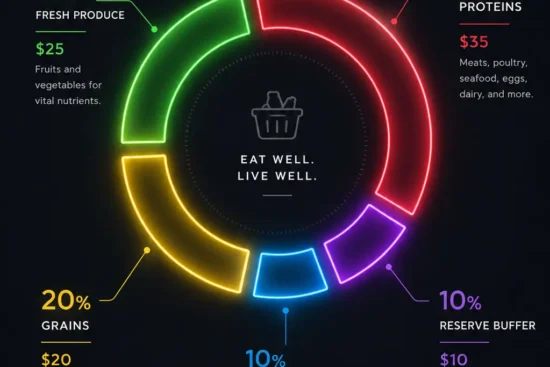
To visualize where your money goes each week, look at this baseline allocation for a single- or two-person household:
- Fresh Produce (Seasonal vegetables & fruit): $22.00 (23.8%)
- Proteins (Chicken thighs, ground turkey, eggs, tofu, beans): $28.00 (30.3%)
- Staples & Grains (Rice, oats, pasta, sweet potatoes): $18.00 (19.5%)
- Dairy & Alternatives (Milk, Greek yogurt, cheese block): $12.00 (13.0%)
- Pantry Essentials (Cooking oils, spices, canned tomatoes): $12.30 (13.4%)
Step-by-Step Strategic Framework to Slash Grocery Costs
Step 1: Master the “Reverse” Meal Planning System
The traditional way people build a weekly grocery budget is highly inefficient. Typically, a shopper finds a few recipes online, writes down a list of required ingredients, and buys them all at the store.
This approach often results in buying rare ingredients that sit unused in your pantry, leading to significant waste. According to national food waste estimates, the average household discards a massive portion of the food they buy, directly draining their bank accounts.
Traditional Method:
Recipe Search ➔ Shopping List ➔ Buying All New Ingredients ➔ High Waste

Reverse Method:
Pantry Inventory ➔ Sales Circular Review ➔ Recipe Selection ➔ Buying Only Gaps ➔ Zero Waste
To optimize your spending, you should use Reverse Meal Planning.
First, audit your refrigerator, freezer, and pantry before you ever write a shopping list. Identify the items that need to be used immediately.
Second, check your local grocery store’s weekly digital flyer to find items on sale.
Third, plan your meals around your existing ingredients and the store’s sale items. Only buy the necessary ingredients to bridge the gaps. This simple shift ensures you buy less food overall and prevents food waste.
Step 2: Decode the Supermarket Layout and Unit Pricing
Supermarkets are carefully designed to make you spend as much money as possible. High-margin items are always placed at eye level, while impulse purchases clutter the checkout lanes.
To keep your grocery budget within your target, you must actively resist these store tricks. Start by focusing on the lower shelves.
Stores typically place their most affordable store brands and bulk packages on the very bottom or top shelves.
[ Top Shelf ]    ➔ Specialized / Bulk Goods (Good Value)
[ Eye-Level ]    ➔ Expensive Name Brands (Highest Margin for Store)
[ Bottom Shelf ] ➔ Store Brands & Budget Options (Best Value for Shopper)
Additionally, you should always check the unit price on the shelf tag, not just the retail price. The unit price tells you exactly what an item costs per ounce, pound, or gram.
For instance, a name-brand cereal might retail for $4.50 ($0.32 per ounce), while a larger store-brand bag retails for $5.50 but costs only $0.18 per ounce. Checking the unit price ensures you get the absolute most value for your money.
Step 3: Shift to a 90% Private Label Strategy
One of the easiest ways to instantly lower your checkout total without buying less food is to swap name-brand items for store brands. Brand loyalty is a major barrier to keeping an affordable grocery budget.
Most store-brand items are made in the exact same manufacturing facilities as their name-brand counterparts. They feature nearly identical nutritional profiles and tastes, but they cost significantly less because they don’t require expensive advertising.
| Product Category | Name Brand Price | Store Brand Price | Percentage Saved |
|---|---|---|---|
| Rolled Oats (32 oz) | $5.49 | $2.89 | 47% |
| Canned Black Beans (15 oz) | $1.79 | $0.89 | 50% |
| Greek Yogurt (32 oz) | $6.29 | $3.99 | 36% |
| Organic Olive Oil (16.9 oz) | $11.99 | $8.49 | 29% |
| Whole Wheat Pasta (16 oz) | $2.49 | $1.39 | 44% |
By switching to store brands for basic pantry items—such as flour, sugar, canned goods, pasta, frozen vegetables, and oats—you can cut your weekly grocery bill by up to 30%.
High-Yield Cash-Back & Financial App Integration
To maximize your savings, you should treat grocery shopping like a business. This means using financial tools that put money back into your pocket with every transaction.
       [ Grocery Purchase ]
               │
       ┌───────┴───────┐
       ▼               ▼
[ Cash-Back Card ]  [ Receipt App ]
(Save 3% to 6%)     (Earn Points/Rebates)
       │               │
       └───────┬───────┘
               ▼
   [ Compounded Savings ]
1. Optimize Your Credit Card Strategy
If you pay for your groceries with cash or a basic debit card, you are leaving money on the table. Instead, use a credit card that offers high cash-back rewards specifically for grocery store purchases.
Many modern credit cards offer between 3% and 6% cash-back on groceries. If you spend $400 a month on groceries, a 5% cash-back card will return $20 directly to your pocket each month, reducing your effective monthly cost to just $380.
Note: Only use this strategy if you pay off your credit card balance in full every single month. Carrying a balance and paying interest will quickly wipe out any cash-back savings.
2. Leverage Receipt Scanning and Rebate Apps
Pair your cash-back credit card with receipt scanning apps to compound your savings. Several financial apps allow you to upload your grocery receipts in exchange for gift cards, cash rebates, or points.
Before heading to the store, check these apps for rebates on items you already plan to buy. When you return home, take a quick photo of your receipt to earn points that can be redeemed for future shopping trips.
The True Cost of Convenience: Delivery vs. Curbside vs. In-Store
With the rise of on-demand delivery apps, many shoppers have grown accustomed to having groceries delivered directly to their doorsteps. However, convenience always comes with a premium that can easily bust an affordable grocery budget.
To understand why, let’s look at how a seemingly simple $80 grocery order ballooned when processed through a delivery app:
Base Grocery Items:     $80.00
In-App Item Markups:    $9.50 (Many apps inflate item prices)
Delivery Fee:           $3.99
Service Fee:            $4.00
Driver Tip (15%):       $13.50
-------------------------------
Total Delivered Cost:   $110.99 (A 38.7% premium!)
This $30.99 convenience premium can quickly add up to over $120 a month in unnecessary fees.
If you struggle with impulse shopping when walking down the aisles, the best alternative is free curbside pickup. Curbside pickup allows you to build your cart online, see your exact total in real time before checking out, and avoid delivery fees and tips. This helps you stick to your budget while keeping you out of the store, avoiding tempting displays.
Strategic Grocery Shopping: Pros & Cons
To keep your grocery budget under $400 monthly, it helps to weigh the benefits and trade-offs of this disciplined approach.
Pros
- Accelerated Financial Goals: Saving $150 to $200 per month compared to the national average frees up cash flow to pay off debt or build an emergency fund.
- Reduced Food Waste: Adopting a strict planning and inventory system ensures that nearly everything you buy gets consumed, helping your wallet and the environment.
- Improved Cooking Skills: Relying less on pre-packaged convenience meals encourages you to cook from scratch, which is healthier and more satisfying.
- Clarity on Needs vs. Wants: You build a disciplined mindset that naturally extends to other areas of personal finance, like housing and transportation.
Cons
- Time Commitment: Planning, inventory tracking, and cooking from scratch require a weekly investment of 3 to 5 hours.
- Reduced Spontaneity: You can no longer make last-minute decisions to dine out or grab pricey specialty items without impacting your budget.
- Initial Learning Curve: Navigating sales cycles, checking unit prices, and cooking with basic ingredients can feel overwhelming at first.
Common Budgeting Pitfalls to Avoid
Even the most organized shoppers can hit roadblocks that disrupt their grocery budget. Awareness of these common pitfalls can help you stay on track:
1. Falling for “Multi-Buy” Sales Traps
Supermarkets frequently run promotions like “10 for $10” or “Buy 2, Get 1 Free.” Many shoppers believe they must buy all ten items to get the discount, but this is rarely the case.
In most stores, you can buy just one item for $1.00. Always read the fine print on the shelf tag to avoid buying more than you actually need.
2. Buying Produce Out of Season
Buying fresh berries in the middle of winter is an easy way to drive up your bill. Out-of-season produce must be shipped from thousands of miles away, and those transportation costs are passed directly on to you.
Instead, buy seasonal produce or opt for frozen fruits and vegetables. Frozen produce is frozen at peak ripeness, holds its nutritional value, and is often much cheaper than fresh alternatives.
3. Shopping While Hungry
It is a classic rule for a reason: shopping on an empty stomach leads to impulsive, comfort-driven purchases. You are much more likely to grab snacks, sweets, and pre-made deli items that aren’t on your list. Eat a quick meal or snack before entering the store to keep your purchasing decisions rational and on-budget.
Expert Insights: How to Stretch Your Ingredients
To learn more about the official benchmarks for affordable dining, check out the USDA Thrifty Food Plan guidelines. This document provides an official breakdown of how to build a nutritious diet on a limited budget.
Financial planning experts often emphasize that saving money on groceries is as much about food preservation as it is about shopping smart. Here are three professional tips to stretch your food:
“Learn to freeze everything.” If you notice fresh spinach, bell peppers, or onions starting to turn, chop them up and freeze them in storage bags. You can use them later in soups, stews, or scrambled eggs.
“Stretch your meat with plant proteins.” When preparing ground beef or turkey for tacos or chili, mix in a can of black beans or cooked brown lentils. This doubles the volume of your meal for a fraction of the cost, while adding fiber and lowering overall fat content.
“Master the pantry challenge.” Once every three months, dedicate an entire week to eating only what is already in your pantry and freezer, buying only fresh milk or produce if absolutely necessary. This clears out older stock and provides a massive boost to your monthly savings.
A Sample $90 Weekly Shopping List
Here is an example of a balanced, nutritious weekly shopping list designed to feed a two-person household for under $90.
Grains & Starches ($14.50)
- Old Fashioned Oats (32 oz, Store Brand): $2.89
- Brown Rice (32 oz bag): $1.89
- Sweet Potatoes (3 lbs bag): $3.49
- Whole Wheat Bread (1 loaf, Store Brand): $1.99
- Whole Wheat Pasta (2 boxes): $2.78
- Yellow Onions (3 lbs bag): $1.46
Proteins & Dairy ($31.50)
- Large Eggs (2 dozen): $7.50
- Boneless Chicken Thighs (3 lbs): $10.47
- Canned Tuna in Water (4 cans): $4.00
- Dry Lentils (16 oz bag): $1.59
- Canned Chickpeas (3 cans): $2.67
- Greek Yogurt (32 oz, Plain): $3.99
- Cottage Cheese (16 oz): $1.28
Fresh & Frozen Produce ($25.50)
- Bananas (3 lbs): $1.77
- Gala Apples (3 lbs bag): $3.99
- Fresh Spinach (10 oz bag): $2.49
- Carrots (2 lbs bag): $1.89
- Frozen Broccoli Florets (4 bags): $6.00
- Frozen Mixed Berries (2 bags): $5.36
- Garlic (3-pack): $1.50
- Lemons (3 units): $2.50
Pantry Staples ($13.50)
- Canned Crushed Tomatoes (2 large cans): $2.98
- Peanut Butter (16 oz): $2.29
- Marinara Sauce (1 jar): $1.89
- Olive Oil Cooking Spray: $2.49
- Spices & Condiments (Salt/Pepper/Garlic Powder): $3.85
Total Weekly Spend: $85.00 (Leaving a $7.30 buffer for taxes or unexpected needs)
Frequently Asked Questions
How can I keep a grocery budget under $400 for a family of four?
For a family of four, keeping a grocery budget under $400 monthly is incredibly challenging and may not provide enough nutrition. However, you can apply these same strategies to stay under the USDA Thrifty Food Plan baseline of roughly $993 a month. Focus heavily on bulk grains, seasonal produce, and dry legumes, while limiting meat consumption and eliminating packaged snacks.
Is organic food possible on a $400 monthly grocery budget?
Yes, but you have to prioritize. Instead of buying everything organic, focus on organic options for the “Dirty Dozen”—produce that typically has higher pesticide residues. For items with thick, inedible skins (the “Clean Fifteen,” like bananas, avocados, and onions), buy conventional to save money.
How do discount grocery stores help save money?
Discount grocery chains keep prices low by optimizing their operations. They often require a small deposit to use a shopping cart, which eliminates the need to hire cart collectors. They also display items in their original shipping boxes to save on stocking labor and sell primarily store brands. These operational savings are passed directly on to you, reducing your overall bill by 20% to 40% compared to traditional supermarkets.
How often should I shop to stay under budget?
Aim to shop once a week. Frequent, mid-week trips to the grocery store often lead to impulse buys and extra spending on convenience items. Planning a single weekly trip forces you to stick to your list and ensures that every item has a clear purpose in your meal plan.
Can couponing help keep my grocery budget under $400?
Yes, but you should prioritize digital store coupons and cash-back apps over traditional paper coupons. Paper coupons are usually for expensive, name-brand processed foods, which are often still more expensive than store-brand basics even with the discount. Focus on digital coupons for store brands, household paper products, and fresh meats.
Should I buy in bulk at warehouse clubs to save money?
Only buy items in bulk that you know you will use before they spoil, such as rice, oats, dry beans, toilet paper, and trash bags. Buying fresh produce or dairy in bulk often leads to food waste, which actually costs you more money in the long run. Always calculate the unit price to verify you are getting a better deal.
Conclusion
Keeping your grocery budget under $400 monthly doesn’t mean you have to sacrifice variety or nutrition. By shifting to a pantry-first planning system, buying store brands, and shopping with a clear, strategic list, you can easily control your spending.
Begin by auditing your pantry today and setting your weekly target at $92.30. Small, consistent shifts in your shopping habits can yield hundreds of dollars in annual savings, helping you reach your financial goals faster.






Leave a Reply